



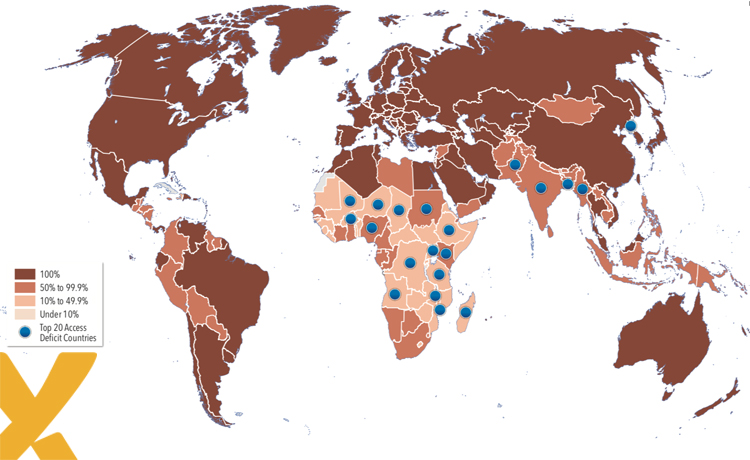
2019. 840 million people have no access to energy
By Rosa González – CFO and BDM Audax Renovables
Energy always available, at any time or in any context: few would dispute this statement. For us, plugging a plug into a socket, pressing a switch, turning the gas knob are nothing more than daily and automatic gestures to which we give no particular meaning. It is no coincidence that most of our days begin with a light that turns on and one that goes off. We are used to it and we are not surprised when the light bulb lights up the room, the smartphone charges or the water heats up. We take it for granted that energy is there, always available to us; rather, we are surprised - and irritated - by the opposite, that is, if it does not happen: blackouts, especially if of a certain magnitude, never cease to cause concern and make the news.
But what is normal for us is not normal for 840 million people in the world, namely those who currently have no access to modern, continuous and safe forms of energy.
The negative consequences of a life without energy on both the existence of individuals and that of nations are multiple, heavy and concern all areas: health, education, economics, social. It is energy - as the discovery and use of more efficient, available and abundant energy sources - that has led to the great revolutions in the history of humanity. From the discovery of fire onwards.
This is what emerges from theEnergy Progress Report 2019, the study promoted by the International Energy Agency-IEA, the International Renewable Energy Agency-IRENA, the United Nations statistics division (Unsd), the World Bank and the World Health Organization-WHO, which annually take a snapshot of the situation of the so-called "access to energy" in the world. This is the objective number 7 of the 17 established by the United Nations; the Sustainable Development Goals (SDGs) o The Sustainable Development Goals have a time horizon of 2030.
But what is the situation today, 2019? The data in the report show that in recent years there has been an improvement, with a significant decrease in the number of people without electricity: from 1.2 billion in 2000, to one billion in 2010, to 840 million today.
This positive trend has led to an increase in the world electrification rate up to 89%, from 83% in 2010. A result visible in certain areas of Latin America, the Caribbean or Southeast Asia that in recent times were poorly or underserved and today boast percentages around 98%. Lower but still important is the goal achieved by the nations of Central and South Asia, with 91%. In particular, nations such as India, Bangladesh and Myanmar have benefited from these advances.
Excluded from this progress, however, is – apart from Kenya – sub-Saharan Africa. There are approximately 573 million Africans who live in the territories beneath the great desert who are still “in the dark”, without any type of access to electricity and therefore in a highly penalizing condition. In this vast area of the African continent are the 20 countries with the lowest percentage of population with access to electricity, among which the last ones are Burundi, Chad, Malawi, the Democratic Republic of Congo and Niger.
Another element of differentiation concerns cities and countryside. If in the former almost all the population has access to electricity (97%), it is in the latter that the greatest problems occur with a percentage that is around 79%.
In any case, beyond the improvements recorded, it is necessary to continue making progress. And not only for those 840 million individuals who - as they say - are still off grid, but also for those who have had the opportunity to connect to the network. For them, in fact, the supply of electricity has very different characteristics from those we experience daily, namely safe - but above all - continuous and sustainable from an economic point of view. In 2017, a third of the countries with problems of access to energy had to face more than one weekly power outage lasting more than four minutes. Furthermore, in half of these nations, considering a basic level of electricity consumption equal to 30 kilowatt hours per month, the price to pay for the supply was unsustainable for as many as 40% of families.
Graph 1. Share of population with access to electricity
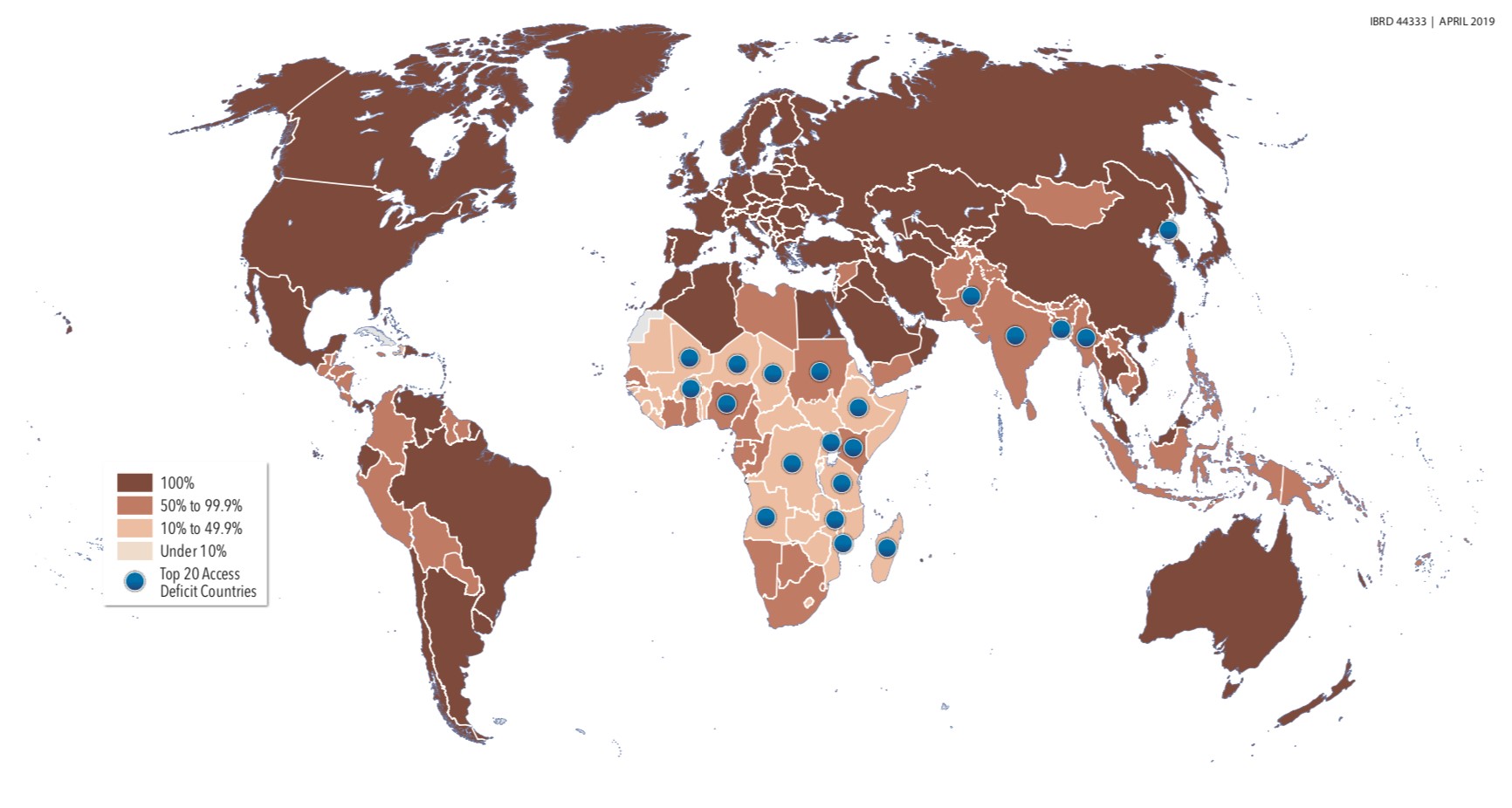
(source: World Bank)
Another aspect of this energy poverty is represented by the lack of access to a safe and healthy food cooking system. Kerosene, biomass (especially wood), coal: today there are about 3 billion people who use fuels that are harmful to both health and the environment to cook - but this also applies to heating and lighting environments. This happens especially in the regions of sub-Saharan Africa and Southeast Asia, with India and China leading the way in terms of population shares excluded from modern cooking systems or "clean cooking" (25% and 20% respectively). Looking at the African continent, less than 5% of the inhabitants of nations such as the Democratic Republic of Congo, Ethiopia, Madagascar, Mozambique, Uganda and Tanzania have the possibility of using clean energy when preparing meals.
The implications and negative impacts are multiple and primarily concern health: breathing in fumes and vapors generated by biomass or fossil fuels on a daily basis, perhaps produced in poorly ventilated environments, is a high risk factor for the onset of various serious pathologies; in this regard, there are categories more exposed such as women and children, more frequently at home than men.
Furthermore, the use of open flames in unsafe premises is dangerous due to the possible occurrence of fires or serious domestic accidents. As if that were not enough, the lack of access to efficient and modern systems brings with it further elements capable of lowering the quality of life of many of these people, such as the fatigue resulting from the daily search and transport of materials to burn, whether wood or other.
Finally, we will talk about the negative effects that such behaviors have on the environment: first and foremost, deforestation and air pollution.
Chart 2. Share of population with access to clean fuels and technologies
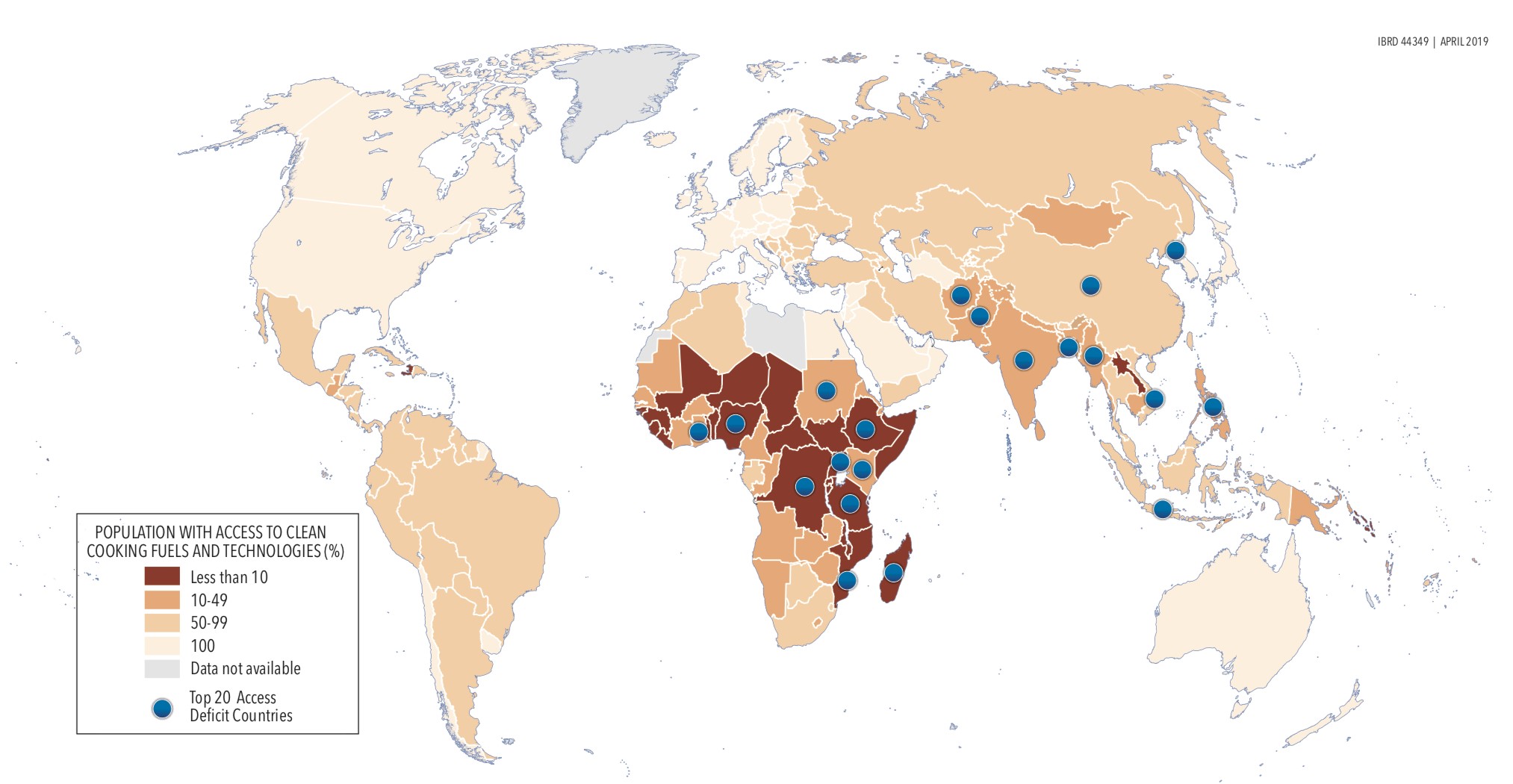
(source: WHO)
What awaits us in the next decades? Projections to 2030 show a further – but unfortunately not decisive – improvement, with over 650 million people still off-grid and without access to energy; of these, 9 out of 10, will live on the African continent, in the sub-Saharan regions.
The same can be said for the issue of “clean cooking”: a non-decisive advancement to solve the problem. The IEA estimate for 2030 is 2.2 billion people still tied to the use of polluting and harmful fuels.
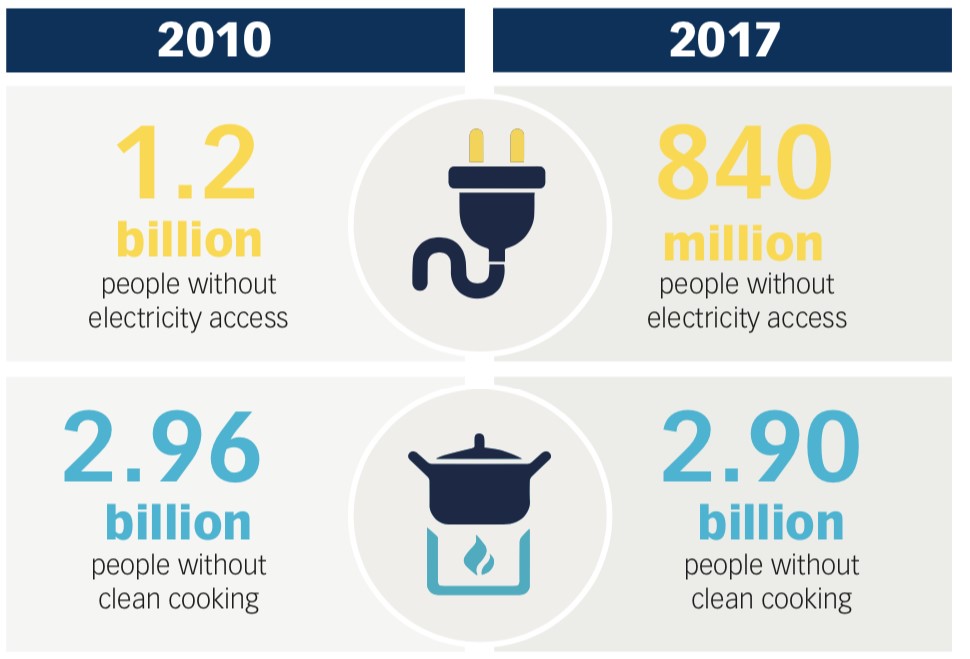
Source: IEA, IRENA, World Bank, WHO, UNSD 2019
Today, projects of varying size and penetration power, implemented by private and public organizations – more or less large – aim to bring energy where there is none. Technological innovation helps, especially for those remote and rural areas where the network will hardly reach: solar energy devices and mini-grids are essential to “take entire communities out of the dark”, improve the quality of life and stimulate economic and social growth.
In the long term, however, the best solution is to develop an energy system that favors the use of clean and renewable sources. This is the challenge to be won.