




RENEWABLES. SOLUTION AND NOT CAUSE OF HIGH BILLS
By Francesco CALABRETTA
Cluster Leader Italy and Hungary Audax Renewables
+30% or even +40% according to Minister Cingolani. These are the estimates of rising energy bills from next October 1st. Arriving at the end of a summer in which we all attempted a cautious return to normal life, these dizzying percentages worry families, businesses and, in general, a country that in the second quarter of 2021, saw its economy grow on average more than the euro area (even France and Germany).
The Government – it's a thing of these days – is intervened urgently. The 3 billion euro allocation is designed to mitigate the effects on the pockets of Italians, starting with the economically weakest groups. As is known, this is the second measure in a few months, after the establishment of a 1.2 billion euro fund established in June.
In short, it should be a sort of three-month shield against the increase in electricity and gas for approximately 3 million low-income families, 6 million micro-enterprises and 26 million domestic users up to 16.5 kw. In addition, a temporary reduction of VAT on gas to 5% is expected from the current levels of 22% (businesses) and 10% (families).
Although the media has only just now reported it with alarm, the price increase was far from unexpected. In fact, it is enough to look back: since the second quarter of 2020, the price of electricity has gone from 16.08 to 22.89 euro cents per kilowatt hour, for an increase of over 40%.
Not only that. The perfect and almost contemporary situation has made the situation more complex combination of factors and their consequences.
First of all the recovery of the world economy. After the slowdown in production activities due to the repercussions of the Covid-19 pandemic, today's recovery has generated a sustained increase in demand for goods and, essentially, raw materials, such as those used to produce energy: natural gas and oil.
We thus arrive at the second cause. If since the spring of 2020, the price of crude oil has risen by more than 200%, since the second quarter of 2021 alone, natural gas has increased by 30%. To give you an idea, 12 months ago international methane prices were between 20 and 30 euros per 1,000 kilowatt hours, today they are between 50 and 60 euros. Speaking then of the wholesale price of a kilowatt hour in Italy, it has gone from 20-40 euros per 1,000 kilowatt hours to 140 euros today.
Although in our country, the gas price rise natural has had a greater impact than in other nations (in our country about 40% of electricity is produced from methane), the high bill is common to other countries such as the United Kingdom, France, Spain and Germany. The situation, which is not always relaxed with Moscow – through which supplies pass for the most part – has further penalized the Old Continent.
The increase in the price of gas on the markets is also linked to the increase in the so-called ETS or Emissions Trade System, the international system for trading permits to emit carbon dioxide. Companies "buy" the possibility to pollute from the European authorities and the permits can be traded and transferred if a company pollutes less than expected. Now, to further limit emissions, their number has been reduced and the price has been increased to 56 euros per ton of CO2 produced. An increase that – it goes without saying – has weighed especially on the companies that pollute the most, among which are those that generate energy from fossil fuels.
Furthermore, the global economic situation is compounded by the structural of our country. A clear example of this is that varied group of accessory voices which, although having little or nothing to do with energy itself, contribute to giving shape to the figure that we all we pay in the invoice. From the RAI license fee to the costs for dismantling structures related to Italian nuclear power up to the well-known incentives on renewables. But not only that. There are national and regional taxes and excise duties and transport costs. In percentage terms, of this hypothetical pie, the “material energy” slice (i.e. what is actually consumed) accounts for approximately 60%, while the remaining 40% is divided between transport and meter management (17.5%), taxes (12.6%), system charges (10.7%). A decidedly substantial slice.
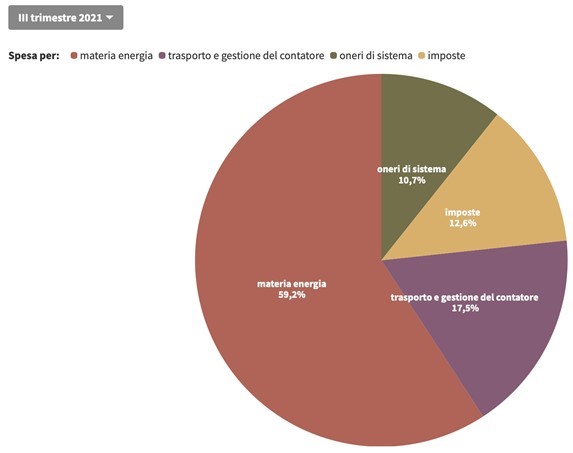
Figure 1. Percentage composition of the electricity price for a typical domestic consumer (September 2021)
Source ARERA
In this regard, in recent days and from various quarters it has been indicated in renewable (and in their incentive), one of the possible culprits of the high bill. But is it really so? More than an in-depth reflection, it appears as a superficial and short-sighted evaluation, especially because in strategic issues for the future - such as energy - we continue to prefer a fleeting benefit today to a lasting well-being tomorrow.
Rather, the current situation is also the result of the failed or still delayed development of sources greenAt the point where we are, the Energy transition It is far from being an option: it is the only path that must be pursued if we want to maintain acceptable living conditions on the Planet.
In Senate hearing on the subject of price increases, Terna's Director of Development and Dispatching Francesco Del Pizzo has called for a greater penetration of renewables. In fact, "if on the one hand they pursue the goal of decarbonization, on the other they will allow us to have less dependence on commodities and a greater capacity to be resilient to such stresses". This means: more renewable sources and storage, less energy produced with gas-powered technologies, which we know are linked to unstable conditions (such as geopolitical factors or the price of CO2 quotas).
So, having faced the emergency of price increases, perhaps the time has come to look at the bill issue in a broader perspective, which includes a profound revision in terms of its composition. ARERA – the competent authority – is in favour of this restyling or if you prefer, redistribution of the items, perhaps with some of them moved from the bill to general taxation.
A necessary but not easy choice because for each decision we must imagine the long-term effect that it can generate and, therefore, its economic sustainability.
In all of this, one thing is certain. A sustainable future lies only in the virtuous union between an energy offer at affordable prices from clean sources. And we at Audax Renewables – as our name already says – believe in it.